A Good Home

Imagination in Memoir Writing

Every so often, I come across a post from a writer who claims that one of the main differences between writing fiction and writing memoir is the use of imagination: fiction writers are unlimited in their use of imagination but memoir writers have to stick to the facts they remember.

Nonsense.

The use of imagination can lift a memoir from a retelling of events as remembered to storytelling at its best. Why?

Most people write a memoir long after the events they describe have passed. If you’re lucky, you may have a photo, a letter, a journal – something to help trigger memories. But most likely, what you have is a sketchy memory of what happened.

Most of the writers I work with are also writing their memoirs long after the people who played a key role in their lives have passed. Almost always, I hear:

“I wish I’d asked my father…”, or “I wish I’d thought to ask my mother…”

~~

Imagination can help us to fill in the blanks. It can help us to paint a picture in the reader’s mind, to flesh out a scene, and enhance our reader’s comprehension of what we’re trying to share.

A bit of imagination can enhance a fragment of memory. It can help you to surmise the season when an event took place, and even the occasion.

“I remember my mother walking down the front steps of our house. I don’t remember what month it was, but I figure it was deep winter because my mother wore her thick winter coat, the good one. The one she wore to church or some special occasion on a very cold day.”

Metaphors and Similes

The tiniest, easiest brushstrokes of imagination are metaphors and similes. They can also deliver big impact.

A simple metaphor can help you hear a sound: “His voice was crushed gravel.”

A simile can be more descriptive than a hundred words. “She was bent over as she walked, looking more like a 90 year old woman than the 50 year old she was.”

“As if”

One of the workshops I most enjoy facilitating is on the use of two words: ‘as if’.

“Write about a scene or feeling you experienced,” I tell the group. “Use the words ‘as if’ to help the reader understand what it was like.”

‘As if’ can be magical – taking both writer and reader into another dimension.

I share one or more examples:

“His insult hit me hard. It was as if he’d punched me in my gut.”

“The morning sun was so bright, it was as if everything around me had turned to gold.”

“My father hung up the phone without speaking but his face was crumpled, as if he had just received disastrous news.”

The next time someone says memoir-writing does not require imagination, don’t accept it. Meanwhile, enjoy using your imagination to bring your writing alive.

My best,

Cynthia.

A Good Home

Yes – I’m a Coach!

Most of you know that I write books and short-form stories. But did you know that I also lead memoir workshops and coach memoir writers?

After publishing 3 successful memoirs, I began teaching and coaching others. My church group, below, was the first to ask me to run a course. (Actually, they bugged me till I agreed!)

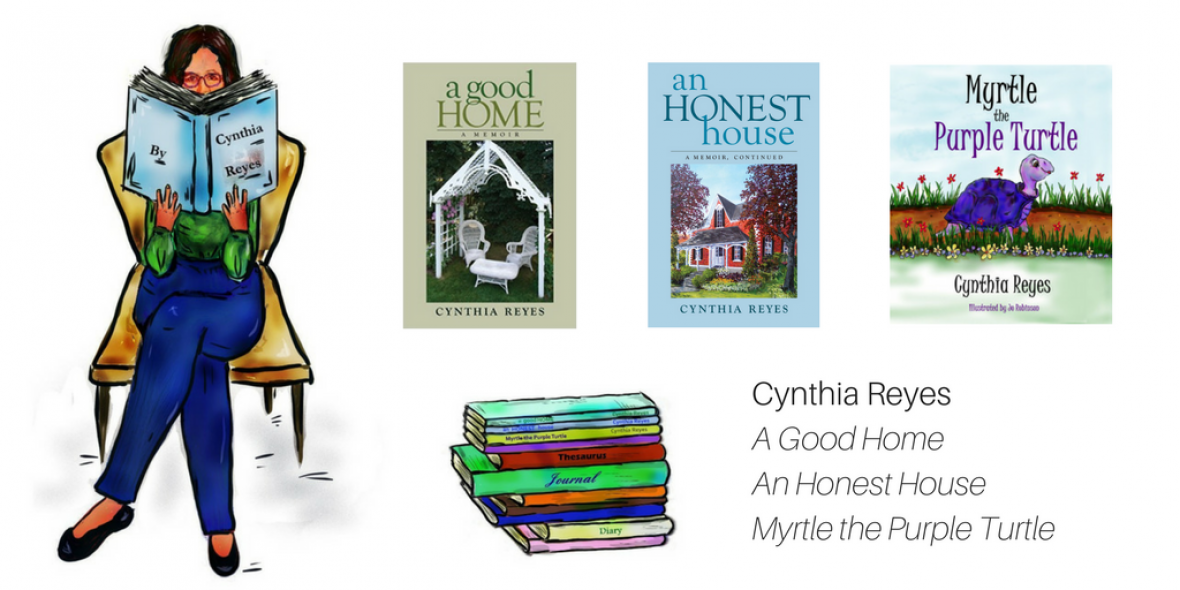
I teach individuals and groups to write an engaging story, first of all. Then to write a book about their own lives. Below are just a few of my students’ books.

Along the way, I made a surprising discovery: anyone can learn to write – and to write their memoir – well. If they have the interest and commitment, I can help them do it.

~~

Strangely enough, I had not written anything for years after a car accident. I struggled to think, write and even speak clearly.

One day, my husband searched for and found dozens of short memoirs I’d written over 25 years before the accident. I’d packed them away and forgotten them.

He urged me to read the stories. But I was still struggling, still angry at myself, and very afraid. Who was that woman – the one who wrote all those stories?

My friend Tim, a fabulous writer-editor, called. He put up with my stuttering, the tears, the inability to hold on to a thought, and offered to read and edit some of those stories.

Like my husband, Tim believed I could learn to write again. He coached, pushed, challenged, encouraged. And, with help from him, two other editors (Lesley and Don), and several dedicated beta readers, I completed and published that first book and two others over 10 years.

I was still healing when I started coaching other memoir writers. But the group was wonderfully patient. Week by week, as my students blossomed, I regained my confidence in speaking, giving feedback, and coaching.

The best part? My students were writing powerful stories about their lives! The results astounded them – all adults over 55, most of whom had never done this kind of thing before.

Over the years, many have gone on to publish books and short memoirs – and some have entered and won writing competitions.

They – and I – are all very proud.

FYI:

To enquire about how I may help you produce your own memoir, please fill in the Memoir Coaching Services form on this site or contact me at:

cynthia@cynthiasreyes.com – don’t forget the ‘s’ in the middle!

~~~

A Good Home

Checking In – Again

Hello, Friends.

Sorry, but the grandchildren and my teaching are winning. Not enough time to blog often – just enough to read some posts, often in the wee hours.

Sharing a rare update:

The Grandchildren

The grandchildren are doing well, thank God. The usual colds, etc. which we’ve come to expect.

The older one is the only 4 year old I know who spends huge after-school time writing and doing her math. She plays a lot, but also badly wants to learn.

The younger one is climbing everything – and trying to become an escape artist in the process. They both melt our hearts daily with their smiles and antics.

Teaching Writing

Teaching has also been rewarding. Not financially – the pay is so small, it’s almost like volunteering. But it delights me to watch my students become skilled writers. Three have had their short stories chosen for a respected anthology, and 4 have already completed the first drafts of their books (memoirs), and sent them to Beta readers. Talk about growth!

The rewards are mutual. I’ve grown alongside the groups I’ve taught.

Lunch with my Writing Students

An Important Lesson

The first year I started teaching writing, I was having a very rough time after a car accident. I wrote in my journal:

“On the first day with (the) group, I decided to reveal my issues that could affect my performance.

“They could already tell I had walking difficulties, so it was easier to address the pain which afflicts me when I stand or sit for long. But it took courage to tell them about the invisible stuff. All have been obvious at different times – the stuttering, strange talking, extreme forgetfulness at times, difficulty getting the words out, and completely losing it if sounds come at me from different directions.

“I also take pre-emptive steps to help me through potential problems. Each agenda is very clear and detailed to keep me on track and to help them help me if I lose my way.

“I don’t remember their names each week, so I started out giving name cards. Those disappeared quickly, so now I wait for the other participants to call each other by name, and I write it down, indicating where they are sitting that day.

“Each week, I remind them to let me know if I’m not being clear. I also stop and ask them: ‘Does that make sense? If it doesn’t, please tell me.’

I think they are deciphering my intent in the rough spots.”

~~~

I’ve shared the above as a reminder to me, and anyone who needs it, that even when times are really bad, there’s still something we can do, and still people who will support you because they see how hard you’re trying.

My very best to you,

Cynthia.

A Good Home

The Kindness of Other Authors

Happy new year, friends!

We all need help and support along the way. As we start 2024, I decided to reblog a post about the authors who helped me in my early days – before I published my first book, A Good Home.

First, Louise Penny. This Canadian author is known for her Inspector Gamache/Three Pines mysteries.  Her lyrical, emotional, insightful writing has won several big awards and put her books on the New York Times bestseller list.

The day I discovered my first Louise Penny book was shortly after I’d turned in my latest feature for a magazine.  That story – written several years before – was titled Possession. It was about the deeply rooted hunger to possess precious things. Louise’s book, The Brutal Telling, was about a deeply-rooted hunger to possess precious things. I was amazed by the serendipity.

Blog - The Brutal Telling

Louise bravely explores that borderland place where the unexplained and the divine intersect with the here and now, the temporal. It’s something I try to do in some of my own writing.

But it was Louise’s own back story – and the similarities between her life and mine — that most surprised me.

We are, I discovered, both Ryerson graduates, both former CBC journalists. But that’s just the stuff that goes into resumes. As I read about her, I realized that we’d both also known what it was like to hit rock-bottom. I was still going through a harrowing fight against painful injuries from a car accident and the very painkillers that were meant to help me cope. Louise had fought a lengthy battle against alcoholism.

I took all these similarities as a sign from above – one of those borderland moments where the divine intersects with the temporal.  It was time, I decided, to get serious about the book I’d started writing a long time ago. But first, I wrote to Louise herself.

Blog - Louise Penny

“The publisher sent me the story layout for my final sign-off just one day before I started your book”, I wrote, referring to Possession, the magazine story, “and as I read your novel, I thought – with a shiver – ‘this is another of my life’s unexplained coincidences’.”

She wrote me back right away: “We seem like sisters,” she said. “I’m glad you’ve discovered my books – and suspect you are a gifted, fabulous writer.”

Such kind encouragement. Louise’s next email contained advice for me as a would-be author. Before you send your manuscript to a publisher or agent, she urged, polish, polish, polish. It’s your one chance, so make it the best it can be.

As I neared the completion of the manuscript, other authors helped.

Blog - Yvonne Blackwood

Yvonne Blackwood, author of Into Africa: The Return, repeatedly helped me polish. She suggested small improvements throughout the text.

Lee Gowan, creative writing professor at the University of Toronto and author of Confession, paid me a precious compliment: he read the manuscript to his mother.

“It was a very moving experience, I can tell you,” Lee wrote.  “Often had a tear or two in my eyes and a hitch in my voice as I was trying to read through.” Lee also stopped me from editing out a whole section of the book that, it turns out, readers love.

Blog - Lee Gowan

When the book was completed, and in the hands of the publisher, I wanted to find out from an author what this next period would be like. Given my need to pace myself, and still attend therapy for long-term injuries, I wanted to make the best of limited resources. Enter Ann Preston, author of The No-Grainer Baker cookbook.

Blog - No Grainer Baker

She was introduced to me by a friend. Ann became a guardian angel, telling me what to expect, and, with her own book on its way to becoming a bestseller, sharing tips by the week.

Blog - Ann Preston

Jan Wong (who self-published her most recent bookOut of the Blue) had experienced both traditional and self publishing. She openly shared her experience with promoting and distributing her books, while I made notes of everything from postage rates for books to dealing with invitations for book readings.

Blog - Jan Wong

Authors Merilyn SimondsOlive Senior and Donna Kakonge also encouraged me.

With wise words of support, small notes of caution, and precious bits of common-sense, these authors helped me to make A Good Home a success. Bravo and Thanks to them all. 

~~~

May 2024 be kind to you and your loved ones.

Cynthia.